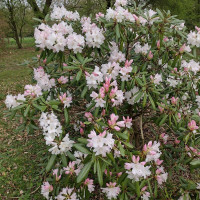
Rhododendron «Farges» (Rhododendron erubescens / oreodoxa var. fargesii) - this is a spectacular evergreen shrub from China, valued for its ornamental qualities and abundant flowering. In mid-spring it is covered with large clusters of pale pink or purplish-pink funnel-shaped flowers, often decorated with spots inside. Thanks to its beauty, winter hardiness, and ability to form a tree-like crown, this species has been awarded the prestigious Royal Horticultural Society Award of Garden Merit (RHS AGM).
The shrub reaches 2–3 meters in height and has grey-green, rounded-ovate leaves that remain decorative throughout the year. The flowers are clustered in racemes, bright and expressive, and the flowering itself is abundant and long-lasting. The plant has a neat, rounded form with a tendency toward a tree-like habit, making it especially attractive in garden compositions.
Rhododendron ‘Farges’ is moderately frost-hardy and is best suited for regions with mild winters. For successful cultivation, it requires acidic, rich, and well-drained soils. It grows best in partial shade or under light tree cover, where it is protected from direct sun and strong winds. It is important to maintain consistent soil moisture while avoiding water stagnation.
Interestingly, the plant is named after the French missionary and plant collector Paul Farges, who discovered it in China at the end of the 19th century. Rhododendron oreodoxa (“beautiful”) is the species to which this variety belongs. Plants of this group are especially popular in regions with mild climates, such as the southern United States, where festivals are even held to celebrate their blooming.
Propagation of rhododendrons by seeds
Substrate composition. The optimal soil acidity at which rhododendrons develop well is within pH 4.0–5.5, although soil with pH 5.8 can also be used. Factors that determine the success of seed propagation in specific introduction conditions include the choice of sowing substrate, moisture regime, temperature, lighting, and seedling care. The substrate for sowing can vary, but it must be loose, acidic, and air-permeable. Fine fibrous rhododendron roots are located in the upper humus layer. Peat is an essential component of soil mixtures for germinating seeds and growing rhododendron seedlings.
The best time for sowing rhododendron seeds in a greenhouse at a temperature of 18–24 °C is November–December. Early sowing is advantageous because it extends the growth period of seedlings, allowing them to develop better during the growing season.
Since rhododendron seeds are very small and require light for germination, they must be sown on the surface without being covered, scattered evenly, and the containers covered with glass. As soon as most seeds germinate, the glass covering is removed, and the containers are moved to a cooler place (15–17 °C), where the young seedlings harden, strengthen, and develop better.
Further care consists of maintaining optimal moisture levels. Overwatering leads to infection, which spreads quickly, and within a few days young seedlings may die. Watering is best done in the morning using a sprayer or a watering can with a fine rose, very carefully.
No questions about this product, be the first and ask your question.